
I don’t enjoy pulling weeds.
Now, mowing? I actually enjoy that. There’s something satisfying about seeing neat lines across a yard. But weeds? Not so much.
Maybe that’s because one summer, between college semesters, I spent my days pulling weeds on a flower farm in northwestern Minnesota.
I was twenty-six years old, a girl from Texas working alongside women who had spent a lifetime working the fields. Most of them were older. Most of them spoke Norwegian to one another. They all spoke English perfectly well, but every now and then one of them would get a mischievous look in her eye, glance over at me, say something in Norwegian, and the rest would laugh.
I never knew what they were saying. But I had a pretty good idea WHO they were talking about.
My friend, who was from that area, fit right in. I was the outsider with the Texas accent, learning one row at a time.
We would scoot along the rows on our backsides or knees, pulling weeds around the plants. At first, I was clueless. I thought you simply grabbed the weed and pulled. I quickly learned there was an actual technique.
If you only pulled the leaves, the weed would snap off and grow back quickly. You had to work your fingers into the soil, loosen the roots, and pull the entire thing out.
It required patience. It required getting your hands dirty.
There was simply no way to rid the rows of weeds while keeping your hands clean. By the end of every day, my fingernails were caked with dirt. My hands were filthy.
But the plants were free to grow.
Fast forward a few decades.
If you’ve been to my house, you probably know I have a special affection for my cannas.
Yes… I talk to them.
This spring, we dug up every bulb, tilled a brand-new garden bed, enriched the soil, and carefully replanted them farther apart. The area had previously been overtaken by volunteer clutter, and I wanted to give the cannas room to thrive.
I’ll admit, I worried. Would they survive the move? Would they bloom? Would I regret disturbing something that had been giving me such great joy for years?
I shouldn’t have worried.
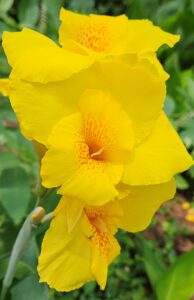
Today they’re taller than I am, covered with brilliant yellow blossoms, and their babies have filled nearly every space I intentionally left between them.
They love the Texas heat. Give them sunshine, water them every other day, and they reward me with beauty that brings me joy every time I even glance out the patio doors.
Unfortunately…
The weeds love that environment too. Especially the vines. Those stubborn, invasive, crawling vines seem determined to wrap themselves around every stalk, weaving their way through the garden. They are designed to crawl up things but I do not want them choking my beloved cannas.
If I ignore them for very long, they begin to choke the very plants, and trees, I’ve worked so hard to grow and care for.
So this morning, there I was again, pulling those same blasted vines. And somewhere between the first pull of their roots and the last…it hit me.
I’ve spent nearly thirty years pulling weeds from dental practices. Not the kind that grow in gardens. The kind that quietly grow inside businesses.
The most dangerous one?
The weed called…
“I’m too busy to oversee.”
I’ve heard it hundreds of times.
“We’ve just been so busy.” “I’ve been meaning to look into that.” “I’ll get to it after things slow down.”
The problem is… Things rarely slow down. And weeds don’t wait.
Neither does embezzlement. Neither do broken systems. Neither do poor accountability processes.
They quietly weave themselves around healthy practices, one unnoticed vine at a time.
By the time someone finally notices something is wrong, the weed has often wrapped itself around every part of the practice.
My largest embezzlement cases didn’t happen because someone woke up one morning and decided to steal a million dollars.
They happened because tiny weeds were allowed to grow unchecked.
No oversight. No accountability. No one taking the time to get their hands dirty.
Healthy practices don’t stay healthy by accident. Just like gardens, they require attention.
You have to notice when something doesn’t belong. You have to pull problems by the root instead of simply trimming what you can see on the surface.
Sometimes that’s uncomfortable. Sometimes it’s messy. Sometimes it means asking difficult questions or implementing systems people would rather avoid.
But healthy things are worth protecting.
I wasn’t pulling weeds this morning because the weather was pleasant. It wasn’t.
It was one of those truly blazing hot and humid Texas mornings where your shirt is soaked before you’ve finished the first section of the garden. I was dripping with sweat and finally stopped—not because I was finished, but because I had a client call scheduled and decided everyone involved would appreciate it if I showered first, especially me.
The weeds didn’t care that it was hot. They weren’t taking the day off because the temperature climbed. They just kept growing.
It occurred to me that problems inside practices behave the same way. Broken systems don’t pause because you’re busy. Embezzlers don’t wait until your schedule clears. Weak accountability doesn’t take the summer off. The weeds keep growing.
The question is whether someone loves what they’re protecting enough to get their hands dirty.
As I was wrapping up my weed pulling this morning, looking at my cannas standing tall with their bright yellow blooms, I realized something else. The flowers never complained about the work. They simply benefited from it.
The same is true of a well-run practice.
Your team may never notice the hours you spend reviewing reports, asking questions, reconciling numbers, or strengthening accountability. Your patients certainly won’t.
But they’ll all benefit from an environment where healthy things are allowed to flourish because someone cared enough to remove what didn’t belong.
Healthy practices don’t become unhealthy overnight. Just like gardens, they become overgrown one weed at a time.
We don’t pull weeds because we hate weeds. We pull weeds because we love the flowers.
The good news?
Gardens can always be reclaimed. So can practices.
It simply begins with someone willing to get their hands dirty.